

So, we reach our number one.
Before we get to that, some of the other gentlemen who contribute to TalkOfTheDevils.co.uk have chosen their top ten.
Dave Murphy – 10. Ronaldo, 9. Keane, 8. Scholes, 7. Law, 6. Edwards, 5. Giggs, 4. Charlton, 3. Best, 2. Cantona, 1. Robson
Nipun Chopra – 10. Keane, 9. Robson, 8. Cantona, 7. Edwards, 6. Scholes, 5. Law, 4. Giggs, 3. Ronaldo, 2. Best, 1. Charlton
Mike Pieri – 10. Law, 9. Cantona, 8. Edwards, 7. Keane, 6. Scholes, 5. Robson, 4. Giggs, 3. Ronaldo, 2. Charlton, 1. Best
1 George Best
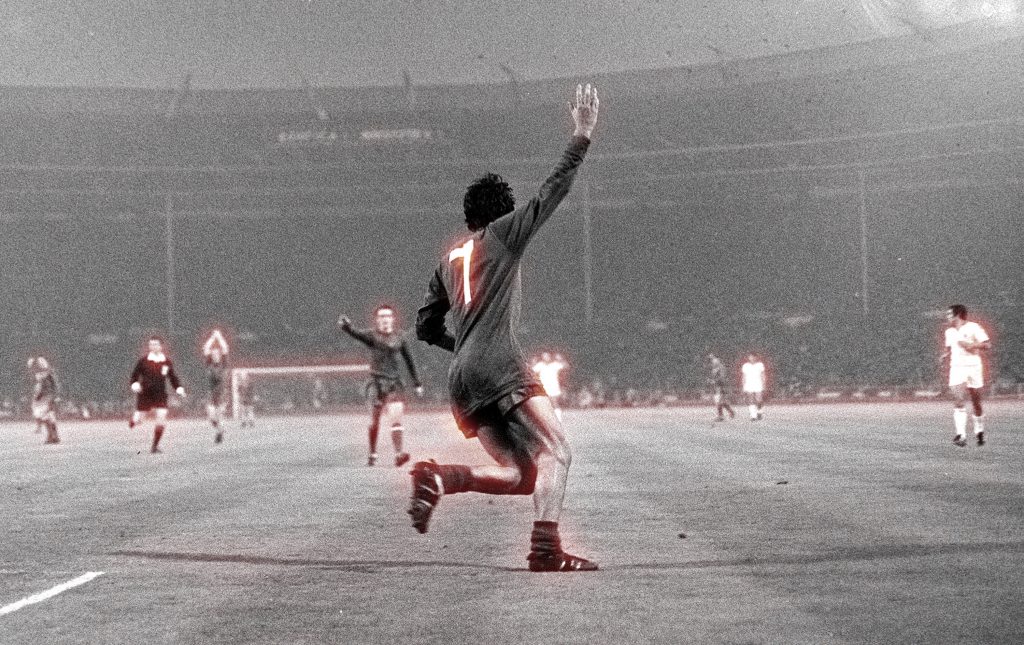
470 appearances, 179 goals
2 League titles, 1 European Cup, 2 Charity Shields
1 Ballon d’Or
Best was just 27 when he walked out on Manchester United for the last time. The truth is that the George Best everyone knew and loved had already been missing for over 18 months anyway. It is a testament to what he accomplished and achieved in the years he played in the first team that he sits atop this list.
The Northern Irishman became the bearer of a new sort of standard at Old Trafford. Where Edwards, Taylor, Charlton and Law had been the best in their areas on the pitch, Best just took it to a new level; he became the showman and the entertainer, the first of his breed at Old Trafford to be so far ahead of his opponent that his skill could embarrass them. It helped that it usually came with an end product.
At his peak, he and United won the European Cup, and although there have been arguably greater goals, there are few more iconic images than Best rounding the Benfica goalkeeper to score the goal which turned out to win at Wembley in 1968. Significantly – there is no more important goal in the club’s history.
Best played with style and panache. He was an all-round player, the original ‘free role’, but not by modern standards. This was a free role player who would go back to help his full-back, usually win the ball, then start the attack from deep. He had everything – there was no weakness to his game. And, when faced with a new challenge, he would simply rise to it. He had not been in the team for three years by the time many in the country described him as the best in the league.
Best’s invention was remarkable; a lofted goal against Chelsea, the six he scored against Northampton Town, the dribble against Sheffield United where it seemed like he beat the entire team, a personal favourite of Best’s where he embarrassed West Ham legend Bobby Moore, and of course the night he announced himself as the world’s first global superstar footballer when he scored twice in a 5-1 win in Benfica’s Stadium of Light in 1966. The stories of him planning to embarrass a team and then executing the plan exactly to blueprint are of legend.
He was simply complete. The best dribbler of the ball you could ever wish to see, the most graceful balance, the most wonderful footballing intelligence. His ability to look like a player three divisions above in the top flight, dancing around agricultural tackles on agricultural pitches.
The legendary sportswriter Hugh McIlvanney once described Best thus : “With feet as sensitive as a pickpocket’s hands, his control of the ball under the most violent pressure was astonishing. The bewildering repertoire of feints and swerves… and balance that would have made Isaac Newton decide he might as well have eaten the apple.”
After the retirement of Sir Matt Busby, Best grew frustrated by being expected to carry a regressing team, and was instead distracted by his celebrity lifestyle. Without Best, United were relegated and had to rebuild under Tommy Docherty.
By 1976 and Best’s 30th birthday, Docherty had made United into top flight contenders again. Where might they have been with Best at what should have been his peak?
The greatest argument of the time was Best v Cruyff v Pele. Pele was a goalscoring machine; Best and Cruyff were known as the game’s artists. Cruyff was arguably a great team player; even some Dutch players who shared a dressing room with Cruyff were forced to confess that Best was a better individual.
He already stands alone as Manchester United’s greatest ever player. But any doubt about him being the greatest that ever walked the planet would surely be rendered ridiculous had illness not taken control.
