

Modern football presented modern problems for the experienced Sir Alex Ferguson.
All season long the Manchester United supremo had boasted about the size of his squad; and regardless of how it went in Moscow, there could be little doubting that this was Fergie’s ‘third’ great team, after his 1994 and 1999 side, proving that even in the post-Bosman, social media celebrity driven era, this wily old Scot from the Glasgow shipyards could roll with the punches.
And yet even he had a dilemma when it came to picking a squad to take to Russia.
Somebody would have to miss out.
“The hardest part is not picking the team but leaving players out of the bench,” he admitted. “We had twenty-six players at Wigan. Keeper Ben Foster is not registered for Europe, but that still leaves us twenty-five for Moscow. And that means seven of them can’t even get stripped and sit on the bench. That is the hardest thing. But I’ve had to do it in the past. I was lucky, in a sense, in Barcelona in 1999 because Roy Keane and Paul Scholes were suspended and Henning Berg was injured and that cut my options down. But, in Rotterdam in 1991 I had to leave Neil Webb and my own son Darren out of the squad. That wasn’t easy. But somebody has to make the decision and the manager is paid to do it. I’m not looking forward to it but I know I’ve got to do it.
“I left out Anderson at Wigan and I included Saha. Saha has been training well for the last ten days and we all know Louis Saha. He is a great talent and can score all types of goals. I just had to include him as one of the subs. Ryan Giggs had to be there. Owen Hargreaves has been absolutely outstanding in recent weeks and in a way leaving him out wasn’t fair. But that meant leaving out John O’Shea, who has been a great servant to us, Darren Fletcher and Anderson. These are fantastic players and it is not easy. You hope they understand that it is a squad game nowadays and they will all play their part. They all seem so hungry for success and that is the thing that pleases you the most. Some Friday mornings, before a game, the training sessions are so competitive and I say to Carlos Queiroz, ‘Come on, stop this now’, because they are really at it and I’m frightened there is going to be an injury. But that is just a measure of their desire to do well all the time. So, we are very fortunate. Good boys, good desire, good talent – combine all that and it gives you a good chance.”
Chelsea boss Avram Grant was in a far more complimentary mood towards Sir Alex ahead of the final than he had been in recent weeks. “I really respect Alex as a person and a manager. He has done a great job,” said Grant. “It’s the second time for him in the final of the Champions League. The first one he won. I’m in my first one in my first year. Not many managers have been in this final. I respect him, but I want to win. We as managers are not as important as what the players do out on the pitch. We have both done a good job up to now.” Grant insisted that he still didn’t feel his job was on the line if Chelsea didn’t win but admitted the location of the game meant it took on extra significance to the man who would decide if he would stay or go — Saratov born Roman Abramovich. “You can imagine,” he added. “He came from here, and he always wanted to be in the final. It’s his dream. I’m not a drinker, but if we win, I’ll drink more than one vodka with him.”
Previewing the game in the build-up was Liverpool legend Alan Hansen, who declared Rio Ferdinand and Nemanja Vidic as the best defensive duo in England. “Rio Ferdinand and Nemanja Vidic are the best centre-back partnership in the Premier League,” Hansen told the BBC. “They earned that tag because the defence conceded only 22 goals in the league this season. That statistic speaks volumes about the job they’ve done because they’re playing in a very, very attacking side. If the team had scored, say, 38 goals in the league, then you would say it’s a defensively minded team anyway. But this side were the top scorers with 80 goals, so it makes their feat all the more impressive. Ferdinand, in particular, has had an unbelievable year. I think, without a shadow of doubt, he was United’s best player in the last three months of the season. Rooney and Ronaldo took the plaudits but when it came to the nitty-gritty, he was head and shoulders above everybody. Ferdinand has really developed as far as his concentration is concerned. If he concentrates and is confident then he’ll have a great game against Chelsea. Both Ferdinand and Vidic are very powerful defensively. Ferdinand is strong on the ball and Vidic is probably more aggressive in the air. They play well off each other and they’re good positionally. They rarely get separated from each other – they just don’t allow space to develop between them.”
Hansen’s view was cleared shared by Sir Alex, who that week sanctioned a £6m deal for Gerard Pique to return to Barcelona. The Spaniard had made a fine contribution to United’s season but it at least made Ferguson’s decision slightly easier in that he was able to name John O’Shea on the bench. Another player guaranteed his place was Paul Scholes, who not only had scored the goal to get United to Moscow, but of course had missed the 1999 Final through suspension.
There was no such promise for Ryan Giggs, despite the prospect of a club record waiting for him. Giggs said the mood in the squad was already competitive as players competed to impress for any selection quirks the manager may have in mind. “I can’t be sure I’ll play. We have a fit squad to choose from – and players will be kicking lumps out of each other over the next week in a bid to try to get into the team,” he admitted. “That’s good for the team because we will all be eager to get picked and to play well. It’s about the squad. The squad won the Champions League in 1999, when Teddy Sheringham and Ole Gunnar Solskjaer came off the bench and scored the goals. The whole squad is together. And we will need to be to beat a very good Chelsea team. You just have to come to terms with the situation. Like I say, it’s a squad game now. I came on at Wigan and scored. I’ve done my bit. Players have to do their bit, right through the team. If you’re not playing, you haven’t got to sulk. When you get on you have to try to prove to the manager that he should have started with you. That’s the determination that has to run right through the squad. You want to play in every game but the manager points out that it’s no longer about 11, 14 or 15 players like it used to be. I think the team is a good age. We have a good mixture of youth and experience, which we had in 1999. Hopefully, players learn from their disappointments, like last year in Milan, plus they get confidence from winning trophies. With all those things, hopefully this team will go on to bigger and better things – starting next week. In 1995 we missed out on the league, then lost the FA Cup. In ’99, we won the league, the FA Cup, then the Champions League. The momentum was with us and we hope it’s with us now. But we aren’t just going to turn up in Moscow because we are champions. We need to play well. We need to do everything well. We need a bit of luck. If we had have lost on Sunday we would still have said we will be ready for Moscow, prepared and looking forward to it.”
Giggs, who had been a goalscoring hero of many semi-finals in the past, did not start either leg against Barcelona and the omens didn’t look good for his inclusion in Moscow. “You just have to come to terms with it,” he said. “You can’t sulk. You just have to try to prove to the manager that he should have started with you.”
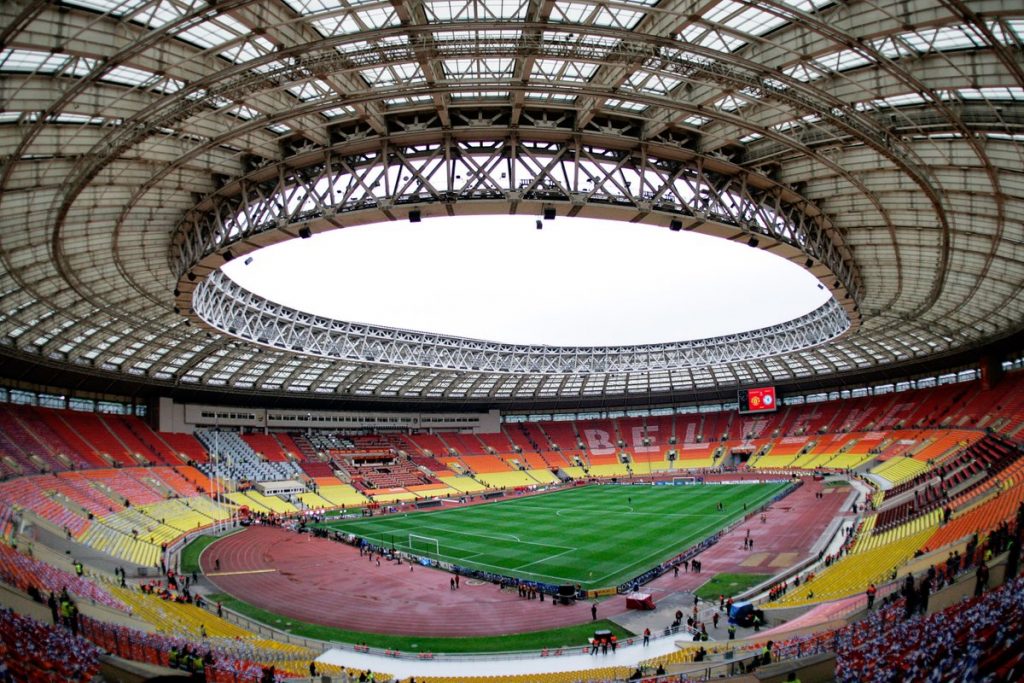
As much attention was paid to the state of the pitch at the Luzhniki Stadium as it was to either team’s selection or tactics. After England had played their Euro 2008 qualifier in the stadium, the synthetic surface had been pulled apart and a grass one was laid especially for the final. With less than a month to go, that pitch was deemed to be too bumpy, and so turf from Slovakia was hastily brought in and laid at a cost of over £150,000. “I’m totally disappointed with the whole project and what we are presenting for the final,” said English-born Matt Frost, the groundsman who had previously promised a ‘Rolls-Royce’ of a pitch. However, both sides trained on the pitch the day before the final and said they were happy with it. “The pitch is the same for both sides and if get the footwear right we will be fine,” John Terry said. “We are not worrying about that at all.”
Sir Alex Ferguson agreed. “I think UEFA have done their best,” he said. “You have to remind yourself that Old Trafford in January or February is not the best in the league.”
On the eve of the final, the theme of the conversation still revolved around the size of Ferguson’s squad and the experience within it. As well as Ryan Giggs in 1999, United could call upon Edwin van der Sar’s experience; the legendary Dutch goalie had won and lost with Ajax in 1995 and 1996 respectively. “The experience he’s got is immense,” Ferguson said. “If you recognise one big change in Manchester United in the last few years it’s in the goalkeeping. We found it hard to replace Schmeichel but his calmness, composure, his presence is phenomenal. He’s a vital, vital player.”
“Last year we had played so many games with the same eleven, 12 players and we had no real reserves to change the game in the final,” said the Scot. “This year we have. That will make the difference. The substitutes you make have got to have an impact, which is why I have to give a lot of consideration to the type of player I want on the bench. If I have to use them I hope they make an impact and in ’99, the two substitutes won it for me. I’ve got the players to do the job – I trust that and will stick by that. We may not have the overall experience of Chelsea in terms of age, but they’ve got the nerve, they’ve got the courage and I think that will make some difference.” Ferguson was in jovial mood, conversational with reporters who had felt the sharp end of his tongue over the season. Asked if he had any final words, the United boss spread his arms out and shouted with a grin, “I love you all! I’ve come to spread peace!” The gathered journalists were howling with laughter as Ferguson left his seat; it was now the turn of his team to put on an entertaining show.
Wednesday, May 21st, 2008. Luzhniki Stadium, Moscow. Att. 69,522
Man Utd: Van der Sar, Brown (Anderson 120), Ferdinand, Vidic, Evra, Hargreaves, Scholes (Giggs 87), Carrick, Ronaldo, Tevez, Rooney (Nani 101).
Subs Not Used: Kuszczak, O’Shea, Fletcher, Silvestre.
Chelsea: Cech, Essien, Carvalho, Terry, Ashley Cole, Ballack, Makelele (Belletti 120), Lampard, Joe Cole (Anelka 99), Drogba, Malouda (Kalou 92).
Subs Not Used: Cudicini, Shevchenko, Obi, Alex.
Owen Hargreaves was the only change from the team which defeated Wigan, coming in for Ji-Sung Park who was not in the squad. Ashley Cole passed a late fitness test for Chelsea after being clattered by Claude Makelele in training; Ricardo Carvalho was also named in the team after speculation he would miss out. There was, however, a surprise tactical move from Ferguson, as Ronaldo was played from the left. The starting line up had led to the suggestion that United might play three in the middle but Ferguson had clearly identified Chelsea’s right side as an area they might be able to exploit. Michael Essien was a superb midfield player but was not a natural right back.
Putting him up against the best player in the world, then, seemed like a sensible way of penetrating a defence with a reputation just as good as United’s. It seemed as if United were concentrating on the flanks and were happy to let Chelsea dominate in the middle of the park; certainly, the early chances came from out wide. After seven minutes Owen Hargreaves’ cross might have seen a better outcome had Rio Ferdinand and Wayne Rooney not challenged each other for it. In his first go at Essien, Ronaldo surged past him, and his cross was just missed by Hargreaves coming in at the back post.
Twenty minutes in and there was the first flashpoint; Paul Scholes challenged Makelele for the high ball — the battle of the biggest little man — and both went down in a heap. Chelsea players surrounded the referee Lubos Michel demanding stern punishment for Scholes and Rooney took umbrage to it, involving himself in the argument. Scholes, however, came off worse, suffering a bloody nose; both Scholes and Makelele were booked, even if the Chelsea man was a little unfortunate. Five minutes later, United had the lead. Scholes and Brown exchanged passes on the right hand side and Brown, running with the ball on the edge of the area, curled a cross with his left foot. At the back post Ronaldo had escaped the attentions of Essien again; the Ghana international had the best view in the house of the winger’s immaculate leap and perfectly timed header towards the near post. Petr Cech had no chance, and Sir Alex Ferguson’s tactical foresight had paid dividends.

Chelsea came back at United and the Reds had a nervy moment when Van der Sar had to save from Rio Ferdinand. But Ferguson’s team could have been out of sight — on one of their blistering counters, Ronaldo got the better of Essien and Cole on the left and crossed for Tevez; his diving header was saved by Cech. On the rebound, Michael Carrick hit a fierce drive which the Chelsea goalkeeper tipped over.
A couple of minutes later, Rooney’s cross was met by Tevez in the middle, but the Argentinian again couldn’t get the contact he’d hoped to. United were the superior side and if they could have been criticised at all it was that their search for a second goal took precedence over protecting the one they had; Chelsea were restricted to efforts from long-range or set-pieces, such as a Michael Ballack free kick effort that went well over after Ferdinand had been booked for a foul on Lampard.
Frustratingly, it was from one of the long-range shots that Chelsea got some luck their performance had scarcely deserved. Essien hit the ball from fully 30 yards in hope rather than expectation; it bounced off Vidic, creating a nightmare situation for Van der Sar, who had already started his dive to smother the ball. The ball seemed to bounce off Rio Ferdinand’s back and the defender couldn’t turn quick enough (though this is not a criticism) to react and get there before Frank Lampard. Lampard had made a career out of those late runs into the box and while not quite as spectacular as Paul Scholes’ semi-final goal, it was just as seminal in a similar respect.
Having surrendered their lead and advantage, United had to accept that the game was more even, and so had to be more disciplined in their approach. Chelsea peppered the United goal with a handful of efforts from long range; it was inevitable that one of them would get somewhere close and that was the case with about twelve minutes to go, when Drogba’s shot from outside the box curled and struck the outside of van der Sar’s post.
With three minutes remaining, Ryan Giggs was brought on for the booked Scholes; in taking to the field, the legendary Welsh player became Manchester United’s record appearance holder. In those dying moments, he was unable to make a contribution before Michel blew for full-time; at the highest level, these sort of sporting occasions are naturally compared with other athletic events.
If one was to liken this to a boxing match, then, after a first round where one fighter had knocked his opponent down with a shattering blow only to taste the canvas himself with a sucker punch, well, in the second round Chelsea had resembled Floyd Mayweather at his most infuriating; organised, defensive, and doing enough to win on points by playing the percentage game.
The only problem for Chelsea is that if their tactic didn’t result in a spectacular goal, it was likely to result in the lottery of penalties, for which there are few analogical sporting equivalents. And so they knew that in extra time they must go for it; four minutes in, and space opened up for Lampard after some stretched defending from United. In a similar position to where he scored his goal from, Lampard hit the bar, but this was a real let off.
Joe Cole then went down with cramp; this was no delaying tactic, or, if it was, it backfired on the England international, who was immediately substituted for Nicolas Anelka. When the ball was back in play Evra charged downfield to receive the ball on the run, just inside the box. It was a scene identical to those two foraging runs into the area the French left-back had made at the Emirates against Arsenal back in the late Autumn, and Petr Cech fell into the same trap, coming out of his goal to try and smother it. Evra’s cut-back found Giggs who was twelve yards out — he stabbed at it, and it seemed as if it would go in, but John Terry displayed the sort of last-gasp defending he was renowned for, getting his head to the ball and clearing it away.
The game was becoming an end-to-end affair with both sides knowing pace on the counter might decide it, so, Ferguson decided to bring Nani on for Rooney to get fresh legs in there. Rooney was looking just a little jaded at the side of Tevez, whose performance hadn’t yet seemed to be affected by fatigue.
Predictably, though, the second half of extra time was a little more cagey, the tension of the affair reflecting what both teams stood to win or lose. Instead of manifesting in good football, it boiled over in the their aggression. Chelsea put the ball out of play so their players could be treated for cramp; Tevez kicked the ball out of play high up the pitch as is customary, but gestured to his team-mates to advance up the pitch to put pressure on them instead of allowing them to start a new attack. John Terry and Michael Ballack took offence and most of the outfield players got involved; it seemed a lot of fuss over nothing but then Drogba, for some reason, decided to slap Vidic; referee Michel didn’t initially see the slap, and booked Ballack for his protests. Michel’s assistant informed him of Drogba’s misdemeanour and the red card was duly shown. United had no real time to take advantage of the extra man before full time, and penalties.
The full-time statistics of this game reveal much; Chelsea had 24 efforts on goal to United’s 12, but only 3 on target as opposed to United’s 5. United had 58% of the possession and completed 130 more passes than their opponents. No amount of stat-padding could make Chelsea look like the dominant team in this final but United would have been cursing luck and misfortune that they let it get this far; and, of course, those are two elements you need on your side when it comes to penalty kicks. If it counted for anything, the kicks would take place in front of United’s fans, and it was the team in red who would go first.
Carlos Tevez was the first man up and his kick, low to his right, sent Cech the wrong way. Michael Ballack, who beat van der Sar from the spot at Stamford Bridge, did so again here. Michael Carrick went in the other corner to Tevez, and Cech guessed wrong again. Belletti then sent United’s goalkeeper the wrong way.
It was then the turn of Cristiano Ronaldo to keep up the one hundred percent record. It was not the kick that could win his team the Cup, but then, Ronaldo had done as much as, if not more than anyone in the United team to put them in this position. Ronaldo didn’t follow the pattern set by Tevez and Carrick and Cech instead repeated his pattern; having dived right, then left, he went right again, and this time, it was the right guess, keeping out the best player in the world’s kick. Ronaldo was visibly distraught, but the truth was this was not one of his better penalty kicks.
For whatever reason, both teams had decided to have their usual taker as the third kicker here, and Frank Lampard did what he usually did, even though van der Sar got a hand to it. Owen Hargreaves emphatically smashed in United’s fourth penalty while Ashley Cole then stepped up to hit an effort that was almost identical to Lampard’s; the former Arsenal’s effort was even weaker, but the United goalkeeper could not get a strong enough hand to claw it out.
The pressure was then on United’s last penalty taker from the regular five; Nani, whose promising first season seemed as if it had ended in disgrace with that stupid red card against West Ham, was thrust into a position where he stood to forever have been remembered for the wrong reasons. You would wonder if he would have ever recovered from the psychological blow of missing; and for a second, it seemed as though he had, as Petr Cech guessed the right way. You could even hear the distinct sound of ball against glove as Cech got a touch. Nani’s kick was perfectly placed, however, and squeezed into the corner.
United had done all they could to recover from the setback of the miss but Chelsea’s 100 per cent strike rate meant that all they needed to do was score the last kick and they would be European Champions. The kicker was John Terry — “Mr Chelsea”, as Sky Sports commentator Martin Tyler described him as he walked up to take the kick. Terry’s stride was confident, though he seemed more pre-occupied with adjusting his captain’s armband to ensure it was showing the big “C”. Terry, the boyhood Manchester United fan, the player who had praised the state of the pitch before the game, slipped at the crucial moment; he did not connect properly with his kick, to the immense relief of van der Sar, who had dived the other way. The ball hit the outside of the post and Terry collapsed to the ground, pushing his head into his knees.
Anderson — who had been brought on for Wes Brown in the last seconds of extra time, especially to take a penalty, was up for the first sudden death kick. He lashed it right down the middle, anticipating correctly that Cech would dive. Suddenly United had been presented with the initiative. Penalty kicks at this level are one of the most complex psychological events a football player has to experience in their entire career and those of us who observe them can only imagine how they deal with the pressure. Imagine, then, the difference in pressure from the first taker compared to the last. Even Owen Hargreaves, as the fourth taker, walked up to the penalty spot knowing that if he missed and Chelsea scored again, the game was up. And even then, when United had restored parity, you have to consider the psychological shift in each player’s approach; Anderson at least had the hope that if he missed, the Chelsea player might miss theirs. And now Salomon Kalou stepped up for the Blues, knowing that there would be no reprieve, there was no second chance if he missed. His successful kick in those circumstances was all the more admirable, even if it wasn’t one of the best penalties you’ve ever seen.
Six penalties taken, one each missed; we were down to those who would generally be reluctant, and United’ next taker was Ryan Giggs. Upon seeing the identity of the taker, there was an audible groan amongst the United fans — not because they expected him to miss, but more, what was associated with this moment, and the intensity which came with it. The groan was immediately followed by a warm applause in appreciation of their record breaker. Throughout the years Giggs had watched as Steve Bruce, Denis Irwin, Eric Cantona, David Beckham, Paul Scholes, Dwight Yorke, Ruud van Nistelrooy, Louis Saha, Wayne Rooney and Ronaldo all enjoyed spells as the regular penalty taker.
A capable free-kick taker, Giggs never pulled rank in that situation either. His only previous penalty kick for United was a missed effort which saw the club eliminated from the 1992 FA Cup against Southampton and it would have taken nerves of steel for that to have not been the first thing in his head as he approached the area.
He had already seen what had happened to Cristiano Ronaldo on this night; Ronaldo, a man who had probably enjoyed the best season of any Manchester United player in history, had been cruelly taunted by fate.
And here was Giggs, setting a new appearance record for the club, with a single potentially decisive kick of a football. Then again, here was Ryan Giggs, ten-times League winner, the most decorated player in the history of English football. If anyone was capable of handling this pressure, it was him; and he was, coolly sending Cech the wrong way from the spot to make us wonder what all the fuss was about. Even his ‘outpouring’ of emotion seemed reserved, as he simply clenched both fists and raised them to head-height in salute of the United fans.
Nicolas Anelka was Chelsea’s seventh taker; the player nicknamed ‘Le Sulk’ throughout his career did not appear to be the happiest person in the world. John Terry was hardly the most popular figure with United fans but if those supporters standing behind the goal could have hoped for anyone to miss a kick, it would be the ex-Arsenal, Liverpool and Manchester City player. Anelka’s run-up was short and unconvincing; his strike was plenty powerful, but at a nice height for Edwin van der Sar, who dived to his right and palmed away the kick. As the United players raced from their embrace to congratulate the goalkeeper, Cristiano Ronaldo collapsed in the middle of the pitch.

As the players danced in front of the supporters, van der Sar and Rio Ferdinand were called over by ITV to talk about their win. “Edwin, what a moment!” the interviewer Gabriel Clarke said. “I know, fucking hell! Sorry!” said the Dutchman, who expressed his pride at winning the trophy again after winning in 1995 and losing on penalties in the final in 1996.
Clarke asked Ferdinand what he thought when Terry stepped up. “I was thinking he’s gonna score,” Rio admitted. “He’s a great penalty taker, normally in training, it’s unfortunate he slipped but for us it’s great… I can’t believe it, look at the fans!”
The rain was belting down but you couldn’t wipe the smile of Sir Alex Ferguson. “I’m so proud of my players,” he beamed. “We deserved it. With the history of this club we deserved to get this trophy tonight. I think the first half we were fantastic. We should have been three or four up by half-time. Second half, I thought they were the better team. Extra time, we got better again. Then that’s the first penalty shoot-out I have ever won in a big game. I won the Charity Shield that way, but that doesn’t really count. The European Cup? The FA Cup? The Scottish cups? Never. I’ve lost three with Aberdeen and three with United, so seventh time lucky — magnificent.”
Edwin van der Sar had been named man of the match by UEFA and Fergie was delighted to present his goalkeeper with a commemorative plaque. “That penalty save was no accident,” said Ferguson. “I have to say I thought it was over when Cristiano missed his penalty. But the slip by John Terry gave us an opening. In 1999 the victory was sudden and unexpected. Here, I told myself that if we take all our penalties correctly then we win it. But once Cristiano Ronaldo missed it became nail-biting and once it was over we all felt incredibly tired. Maybe it was fate, him missing his kick like that. I really think fate has played its hand. I said that we wouldn’t let down the memory of the Busby Babes. We had a cause and that was very important because people with causes are very difficult for people to barter against. So I’m very, very proud. Sometimes you have to pinch yourself but the thing about me is that I don’t get carried away.
“For me the moment of euphoria was when Edwin saved that penalty. I feel very proud and sometimes you have to pinch yourself that it has happened to you. But the feelings drain away quite quickly. I will soon start thinking about next season and of defending the European Cup and I couldn’t tell you what kind of game this was as a final. I spoke to a few people afterwards and they said it was a great match to watch, which is pleasing because some finals have been absolutely terrible and all because of the pressure. Tomorrow morning I will be thinking about next season. It drains away very quickly — that drug, that final moment, that save, it vanishes for me. I will be thinking about the future and looking into the players’ eyes to make sure their hunger is still there. I won’t be retiring.”
It was a night for affirmations, a night for declaring love for this magnificent club. “Well this is football, you know, I score a goal in the game but I miss the penalty… this happened, and I feel very proud for the lads, the lads believed all the time and the lads deserved to win the Champions League,” Ronaldo told ITV, and he later told the Guardian: “I’m going to stay. How could I leave after that? I thought we would lose when I missed my penalty. I thought it would be the worst day of my life. Now it’s the happiest day of my life.”
Ryan Giggs betrayed himself to show rare emotion, but his post-match comments were very much of the type you’d expect from a serial winner. “I couldn’t have done it (broken the appearance record) on a better night,” said Giggs. “To play that many games for this club is brilliant but it’s about winning trophies. I have been fortunate to win a lot. Hopefully I will have more. We’ve won it three times now but we want to win it more.”
